
 Why Agentic AI
If you’ve used a chatbot, you already know what AI can do at its most basic level. Rewrite this paragraph. Quiz me on this topic. Summarize this report. Find a pattern in this spreadsheet. That’s useful, and for a lot of everyday tasks, it’s enough.
But notice what you’re still doing: planning the next step, picking the right tool, checking whether the answer is right, and following through until the job is actually done. The AI gave you a response. You carried the work.
Agentic AI moves more of that work into the system itself. That’s why it matters. This is the difference from the tool being a kitchen knife to the kitchen itself. It changes the basic unit of software from the response to the completed task.
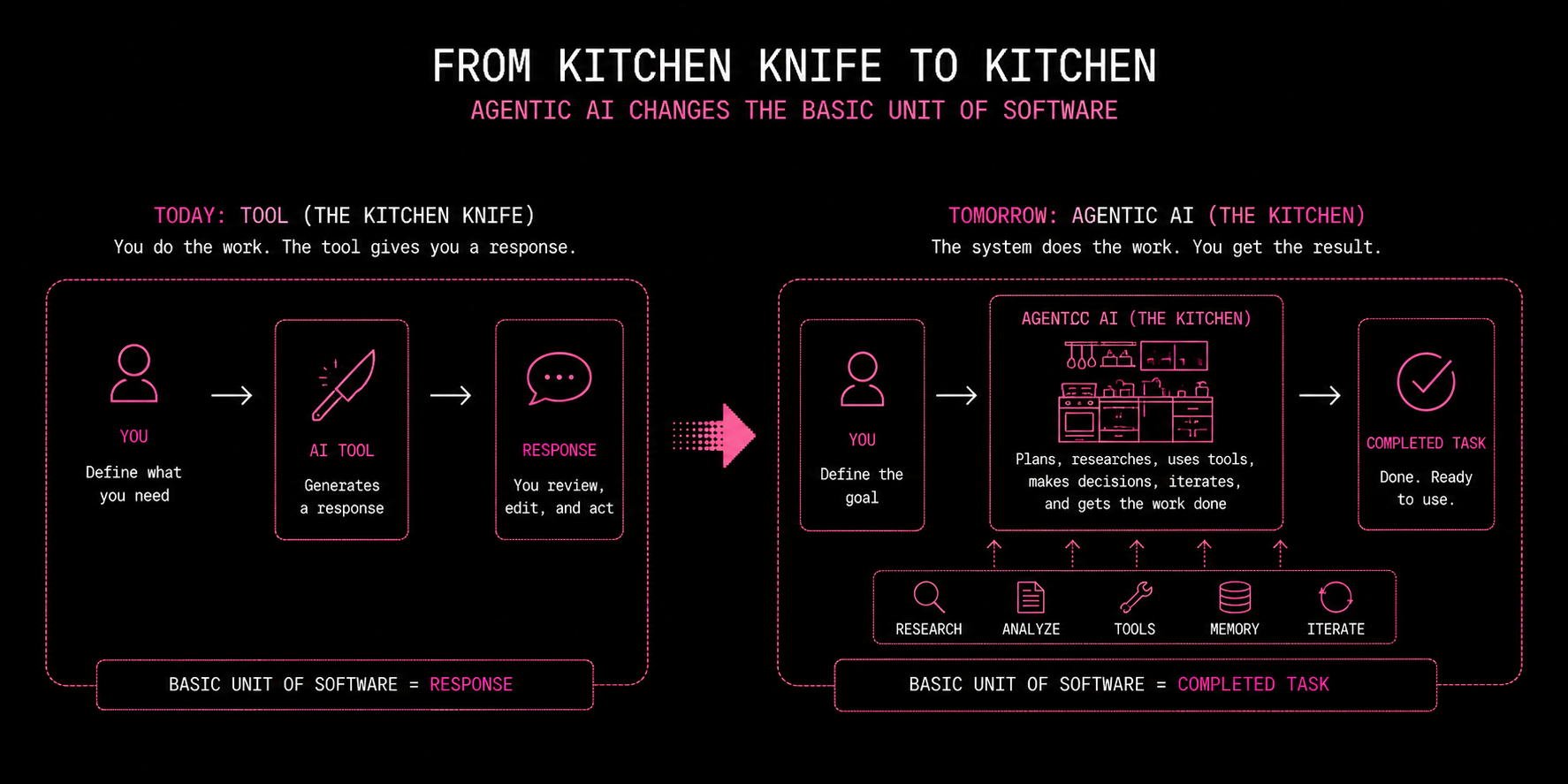
From Answers to Actions
Here’s a concrete difference.
A regular AI assistant might summarize a customer complaint. Fine. You still have to look up the customer’s history, check what they bought, draft a reply, open a support ticket, figure out refund policy, and get someone to sign off before anything goes out.
An agentic system can do more of that chain: summarize the complaint, pull the customer’s history, check recent product usage, draft a response, open a support task, suggest a refund approach, and ask a human to approve the final message.
Same intelligence underneath. Different architecture. Agentic systems combine language models with tools, memory, planning, permissions, and feedback loops — so the system can pursue a goal, not just produce text.
Why one-shot AI hits a wall
Large language models are powerful. But a single model call has natural limits:
- It can hallucinate and sound confident anyway.
- It only knows what’s in its prompt or training data.
- It has no memory unless the surrounding system gives it some.
- It can’t verify facts in the real world without tools.
- It struggles when the work needs many decisions over time, and has a tendency to miss steps, the more there are.
Agentic AI turns one-shot generation into a process. The agent can plan, act, see what happened, revise, and keep going until the goal is done, or until a guardrail says stop. Specialized agents for specific tasks also tend to hallucinate less and finish complex work more reliably than one generalist trying to do everything.
What an Agent Actually Is
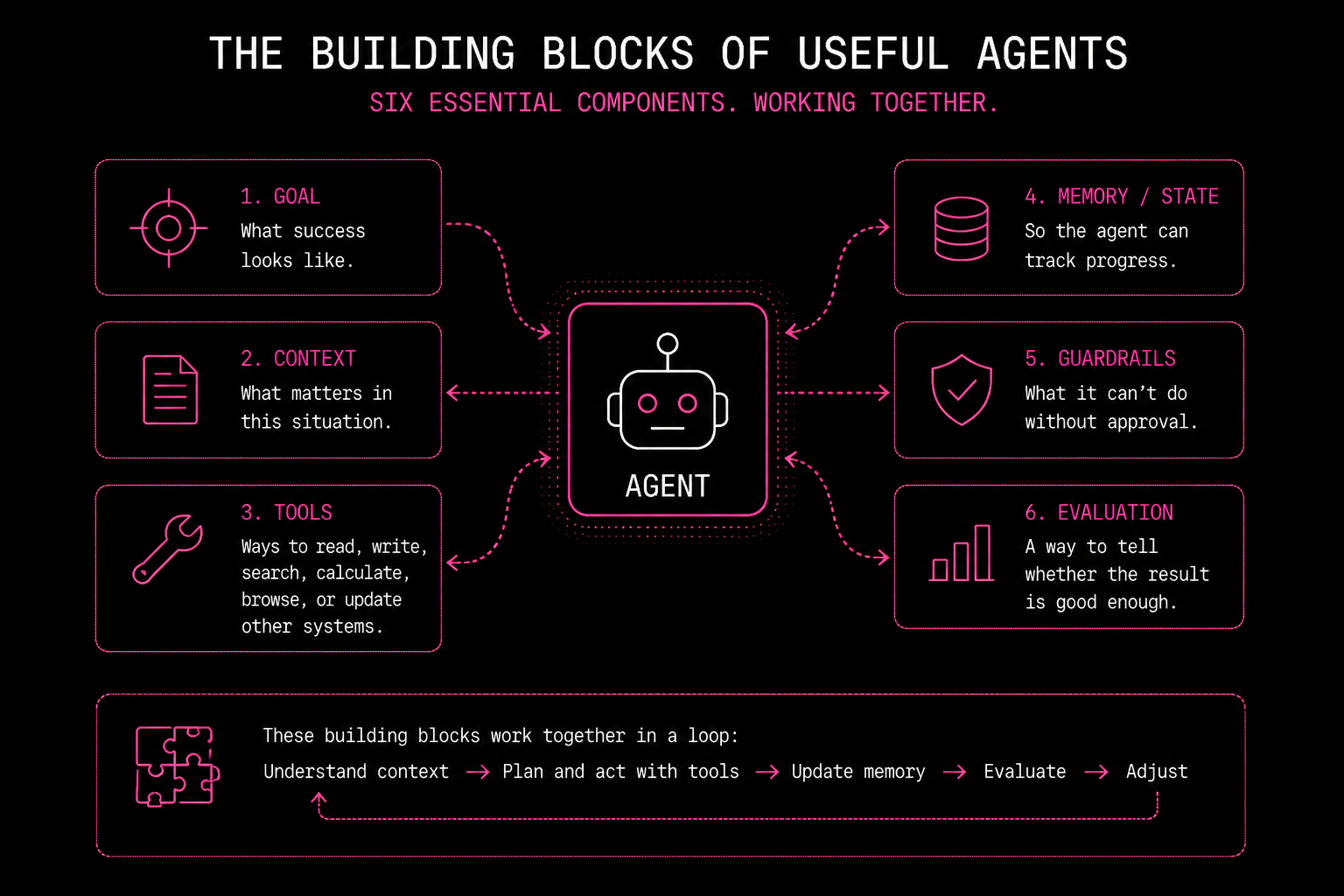
Useful agents usually share a few building blocks:
- A goal — what success looks like.
- Context — what matters in this situation.
- Tools — ways to read, write, search, calculate, browse, or update other systems.
- Memory or state — so the agent can track progress.
- Guardrails — what it can’t do without approval.
- Evaluation — a way to tell whether the result is good enough.
The model is only one part. The workflow around it (how much autonomy you grant, what context you provide, where humans review) determines whether the agent is actually reliable.
Agents aren’t all one shape, either. Some gather information. Some take action. Some chain together with other agents. Some orchestrate, firing off specialists the way a team lead divides work. Same family of ideas, different roles. This is important point as chaining agents which have a specific task together can work better than creating a single large system with its potential for drift.
Three Ways to Use AI (and Why Not Everything Should Be an Agent)
Here’s something worth saying plainly: agentic AI doesn’t mean “turn everything into an agent.” There are three useful modes, and picking the right one is part of the skill.
| Mode | What it is | Best for |
|---|---|---|
| Skills | Repeatable instructions you wrap up and reuse — often lightweight, often local to your setup | Processes you run again and again: writing a blog post in a consistent style, pulling session info before an event, formatting research notes |
| Agents | Callable capabilities that live somewhere central — with backends, storage, and connections to real systems | Processing a lot of data, plugging into tools like Apify or Salesforce, shared team workflows: LinkedIn research, a relationship tracker, an ICP lookup tool |
| Apps | Software with a shared interface people actually sit in front of | Dashboards, team tools, anything where the experience matters: collecting leads at a conference, visualizing performance, coordinating a group |
Skills are thin and fast. Agents are shareable and updatable: when the person who hosts an agent improves it, everyone who calls it gets the improvement. Apps are still the right answer when you need a UI, a shared experience, or a place for a team to work together.
You don’t have to pick one forever. A smart workflow might use all three. The point is to match the shape of the work, not default to “agent” because it’s the hot word this year.
Why Now?
Agentic AI isn’t a sudden invention. It’s the moment several slow trends finally line up.
The models crossed a threshold. They’re better at using tools, reasoning through ambiguity, generating working code, and holding a plan across many steps instead of losing the thread after one answer.
The world those models act on opened up. Mature APIs and dependable browser automation mean agents can operate the same software a person would.
Standard protocols like MCP give agents a common way to reach tools and data, so every integration doesn’t have to be built from scratch.
Once individual agents got dependable, agent-to-agent patterns made it possible to hand work between specialists.
And underneath all of it: businesses have spent heavily on AI and are being asked what they got for it. The pressure to convert that investment into measurable outcomes pulls naturally toward systems that complete work, not just describe it.
Put together, that’s a shift from “AI as a feature” to “AI as an operator.” From something you consult to something that gets things done.
What This Means for Business
In the app economy, companies optimized for engagement: more seats, more dashboards, more usage, more time in product.
In the agentic economy, people care more about outcomes: resolved tickets, booked meetings, reconciled invoices, completed research, fixed bugs, approved claims, shipped campaigns. Customers want results. Employees are expected to produce more with the tools they have: deeper research before a blog goes out, routine legal questions handled without burning specialist time, customer queries resolved instantly (or escalated cleanly when the agent doesn’t know).
That changes product strategy. Software has to become callable, observable, permissioned, and measurable. A product that agents can’t understand or use may become invisible in workflows where an agent chooses tools on behalf of the user.
What This Means for You
If you’re a business professional this is the part that lands on your desk.
Agents are remarkably easy to build now. People who never called themselves developers are putting useful agents together. But ease of building doesn’t mean the thinking is optional. Understanding the rudiments of what an agent is, when to use one, how much autonomy to grant, is a genuinely useful skill. You can go deep later (solution architecture, multi-agent systems, orchestration). You don’t have to start there.
The hard part has shifted. Prompting still matters, but it’s no longer the whole job. The harder work is design: scoping autonomy, structuring context, choosing tools, placing human review points, planning for failure, and defining what success looks like so the system can tell whether it got there.
That’s not exotic. It’s the discipline of turning a messy real-world workflow (which is full of exceptions and judgment calls) into something an agent can run reliably.
Start small. Pick one workflow. Give the agent limited authority. Keep a human in the loop. Learn what reliability actually takes before you scale up.
A marketing automation specialist might build an agent that watches email performance and surfaces ideas for what to test next. That’s not a moonshot. It’s a Tuesday afternoon project that saves hours every week, and it’s the kind of thing you can wrap up, share, and let others use without rebuilding from scratch.
Understanding where agents sit in the broader picture of AI at work is exactly what Agentic Business Schooled is built around.
Ready to Go Further?
The best way to learn this isn’t to read another abstract essay. Build something small, see what breaks, fix it, and build again.
- Build your first AI agent — ship a working agent in about 15 minutes.
- Browse the curriculum — multiple lessons, roughly ten minutes each, each ending with one thing to try.