
 An Agent To Test Your Business Idea
A team has twenty promising ideas for an app and one difficult question: which problems have enough evidence behind them to deserve more work? Quick searches are inconsistent, opinions are noisy, and asking every participant to create several research accounts slows the exercise down.
The App Demand Validator turns one idea into a structured Markdown report using several kinds of evidence: what people search for, which mobile apps already exist, what people are discussing publicly, and which websites or organizations already address the problem. It is useful when a team wants a repeatable first-pass demand test instead of a collection of hunches and browser tabs.
Want the full recipe? Here is the reusable guide an AI builder can follow.
You can try via this web interface or open the finished App Demand Validator on Blocks.
What You Are Building
This is a research helper for classrooms, founders, product teams, and innovation workshops. A user can enter an idea such as: “Map walking and cycling routes that offer more shade during extreme heat.” They can describe the audience and market, choose a platform, and select the research depth.
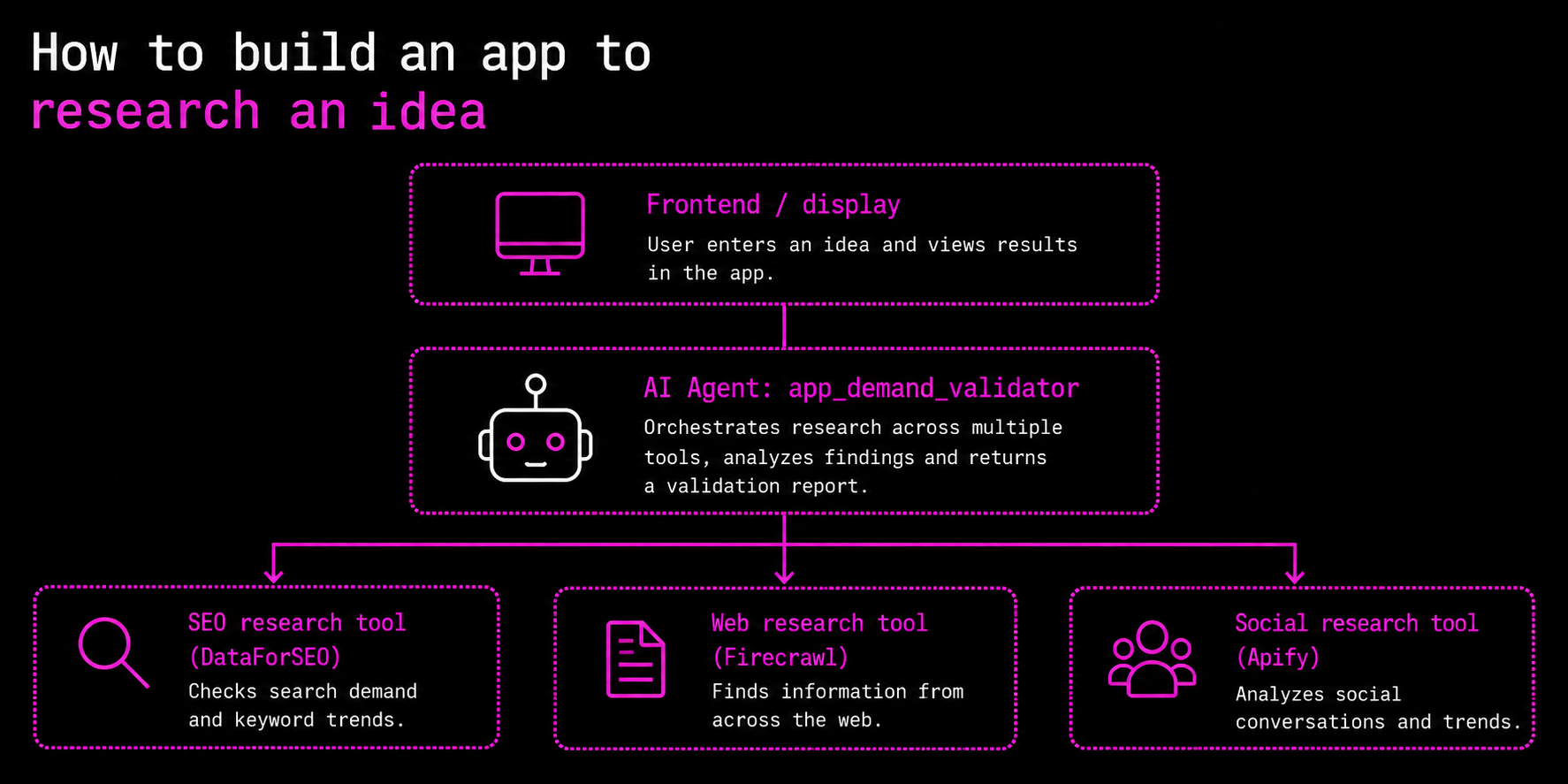
Behind the scenes it works in three steps:
- The user provides the idea, intended audience, market, and optional known competitors.
- The agent turns the idea into testable queries and, depending on the selected toggles, gathers evidence from DataForSEO, Apify, and Firecrawl.
- It returns a Markdown report with a verdict, scorecard, source-by-source findings, the actual queries used, recommendations, and limitations.
Each source answers a different question. DataForSEO shows search demand and mobile-app competition. Apify collects recent public conversations. Firecrawl finds websites and organizations already addressing the problem. Together, they reveal signals that one channel alone may miss.
The main operating advantage is shared access. The owner connects the research services once, keeps keys on the server, and controls budgets and rate limits. Teammates use one approved interface; they do not each register for DataForSEO, Apify, Firecrawl, or OpenAI. The operator remains responsible for access, costs, and provider terms.
The agent runs on Blocks Network and Railway. It accepts ten active classroom requests, queues more, and defaults to a light DataForSEO study. Apify and Firecrawl are optional because they add time and usage.
The business value is straightforward: the whole team can apply the same evidence standard to every idea without turning research-tool administration into the assignment.
Starter Prompt
Use this reusable guide:
https://raw.githubusercontent.com/CagedEther/agentic-business-schooled/refs/heads/main/app-demand-validator-skill.md

Build or adapt a demand-validation agent for [TEAM OR ORGANIZATION]. It should evaluate [TYPE OF IDEAS] for [AUDIENCE] in [PRIMARY MARKET]. Use [DATAFORSEO / APIFY / FIRECRAWL] as the preferred evidence sources and deploy it to [BLOCKS + RAILWAY / OTHER TARGET].

Give non-technical users one shared interface so they do not need separate accounts for each research provider. Keep all API credentials server-side, document the accounts and environment variables the operator needs, add cost and rate controls, and return a Markdown report that shows source-specific findings and the exact queries used. Validate the input schema, run automated checks, and complete one small light-mode end-to-end test using this sample idea: [APP IDEA].
What to Expect As a Good Result
A good result is a shared agent that makes its evidence auditable. The report shows what was measured, which tools were enabled, the queries used, what competitors or websites appeared, and what could not be concluded.
Expect these sections:
# App Demand Report

## Executive verdict
## Idea and audience
## Demand scorecard
## DataForSEO research - SEO and mobile apps
## Apify research - social conversation
## Firecrawl research - website landscape
## Actual demand queries used
## Overall insights and recommendations
## Methodology and limitations
A disabled source should be marked as skipped. Missing volume should say “Not reported,” not zero. Social counts represent observed conversation, not customers. Recommendations should identify an inexpensive next experiment.
What to Try Next
If you have several ideas to test, you can use one agent as an orchestrator that kicks off multiple tasks, and then compares reports with one rubric. This is a way to quickly identify which ideas are worth pursuing.
Note that with tools like this, you should use them as input for your own ideation, brainstorming, and validation. Do not consider this as a final polished go / no-go business report.